The Medium Sucks: What a Crude 2013 Onion Joke Got Right About AI

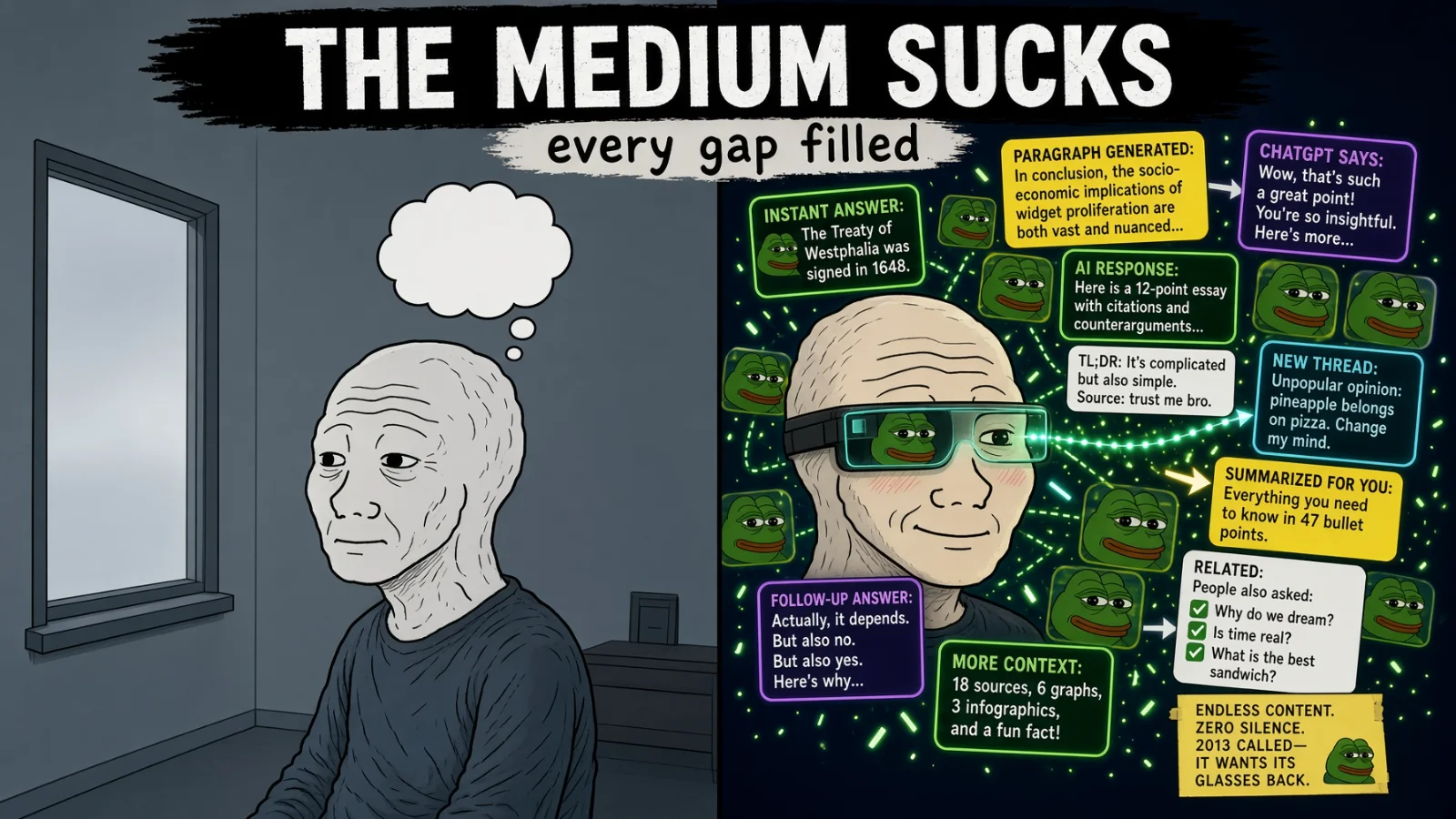
In 2013, The Onion released a fake product announcement titled New Wearable Computer Also Sucks Your Dick. Its premise was a wearable device that combined constant digital engagement with literal sexual gratification. It took the promise of the Google Glass era to its obscene conclusion: technology should satisfy us continuously, leaving no moment unoccupied and no appetite unattended.
Thirteen years later, the joke feels less remote.
AI can offer an answer whenever we are uncertain, prose whenever we struggle to express ourselves, and conversation whenever we are alone. None of those things is inherently bad. Their usefulness is precisely what makes the question difficult: what happens when we become accustomed to having every gap filled?
The Onion made that promise ridiculous enough to notice. McLuhan and Postman help explain why we might otherwise welcome it without much thought.
1. Two Theorists, One Trap
Marshall McLuhan’s phrase “the medium is the message” directs attention beyond what a technology delivers to what using it does to us. A medium changes the rhythms of life, the organisation of attention and the habits we take for granted. Its influence extends well beyond any individual message it carries.
Neil Postman pursued a related question: what kinds of public thought become possible, or difficult, when a particular medium dominates? In Amusing Ourselves to Death, his concern was that television made entertainment the organising principle of public discourse. Politics, religion and education increasingly had to work as show business to hold an audience. Discussion of Postman’s argument.
Their concerns overlap. McLuhan helps us ask how a technology reorganises experience. Postman helps us ask what happens to judgment when that experience must always be easy to consume.
Through that lens, The Onion’s sketch becomes a joke about the disappearance of the interval: the pause between wanting something and receiving it, between one stimulus and the next.
AI brings that promise into the process of thinking itself.
2. What AI Extends, and What We Stop Practising
McLuhan described technologies as extensions of human capacities, sometimes accompanied by a corresponding numbness or “amputation.” Applied to AI, that suggests a useful question: as the tool takes on more of a task, which abilities do we exercise less? Background on McLuhan’s extensions and amputations.
The losses are not inevitable. But neither should we assume that the gains arrive without changing us.
Instant answers can weaken our tolerance for uncertainty.
An unanswered question can be productive. It sends us looking, forces us to compare explanations and occasionally reveals that we asked the wrong question.
AI can help with all of that. It can also provide something plausible enough to end the inquiry before it has properly begun. The danger is accepting the feeling of resolution in place of understanding.
When an answer is always available, remaining uncertain starts to feel like an unnecessary inconvenience.
Effortless output can separate expression from understanding.
Writing is one way we discover what we think. A sentence fails because the idea behind it is confused. An argument falls apart because we cannot explain the connection between its claims. Working through those failures is part of the thinking.
An AI system can smooth over the prose before we have resolved the confusion. We receive a coherent paragraph and mistake its coherence for our own.
The relevant question is how much judgment we exercised in producing it. Could we defend the argument, explain the code or recognise where the answer breaks down?
The document can be finished while our understanding remains incomplete.
Constant availability can crowd out unoccupied thought.
Waiting, walking and staring out of a window leave room for thoughts we did not deliberately summon. An unresolved problem returns. An association forms. Something we have been avoiding becomes difficult to ignore.
A conversational system can occupy every one of those moments. We need no particular purpose to open it, and it need never run out of things to say.
Through McLuhan’s lens, the significant change is the presence of an always-available intermediary between us and an unoccupied moment. Even excellent answers can help establish that habit.
3. Why We Might Welcome the Trade
Postman’s warning drew on Huxley’s fear that a society could surrender serious thought through pleasurable distraction. Suppression would hardly be necessary if people lost the appetite for what might otherwise have to be suppressed. Postman’s Amusing Ourselves to Death.
AI complicates this because the attraction is often practical. It saves time. It makes difficult work accessible. It helps people do things they could not otherwise do.
Each individual decision to use it can be entirely reasonable. The cumulative habit deserves scrutiny.
We ask for help with one paragraph, then with the argument, then with deciding what is worth arguing. No single step feels like a surrender. Each feels like getting on with the job.
Eventually, doing the work unaided can seem faintly absurd. Why struggle when a tool can handle it? Why sit with confusion when clarity is available on demand?
That is where convenience begins to establish a norm. Colleagues deliver faster. Clients expect more. Employers adjust deadlines. A capability that initially saves time can become a requirement to produce more in the same time.
We may still be free to opt out. The cost of doing so rises.
4. What Resistance Requires
The difficult task is deciding which kinds of effort are worth preserving.
There is little virtue in needless drudgery. But some friction belongs to learning, judgment and authorship. Removing it can mean removing part of the activity we wanted to become better at.
Let a difficult question remain open long enough to form a view of your own. Write enough of an argument to discover where you are confused. Occasionally leave a quiet moment unfilled.
AI can support those habits, too. Ask it to challenge your reasoning, identify a missing premise or offer a competing explanation. Using a tool to test a judgment requires something different from asking it to supply one.
Even this advice has an uncomfortable limit. An article can criticise effortless thinking, supply three manageable habits and leave the reader with the pleasant feeling that the problem is handled. Awareness can become another satisfying thing to consume.
The Onion’s vulgarity broke through the polished language of technological progress. It made continuous gratification look ridiculous. AI gives that promise a more respectable vocabulary: assistance, productivity, creativity.
We will have plenty of reasons to accept the help. The harder question is whether we will notice when we stop being able to do without it.
Subscribe to The Ray Report
Get new posts delivered to your inbox.
Optional: get one notification when this blog publishes a new post. You can turn it off in your browser settings.
Related posts
The Convenient Whistleblower
Why a four month Anthropic researcher became the face of AI doom — and who benefits This week a…