Intelligence You Can Keep

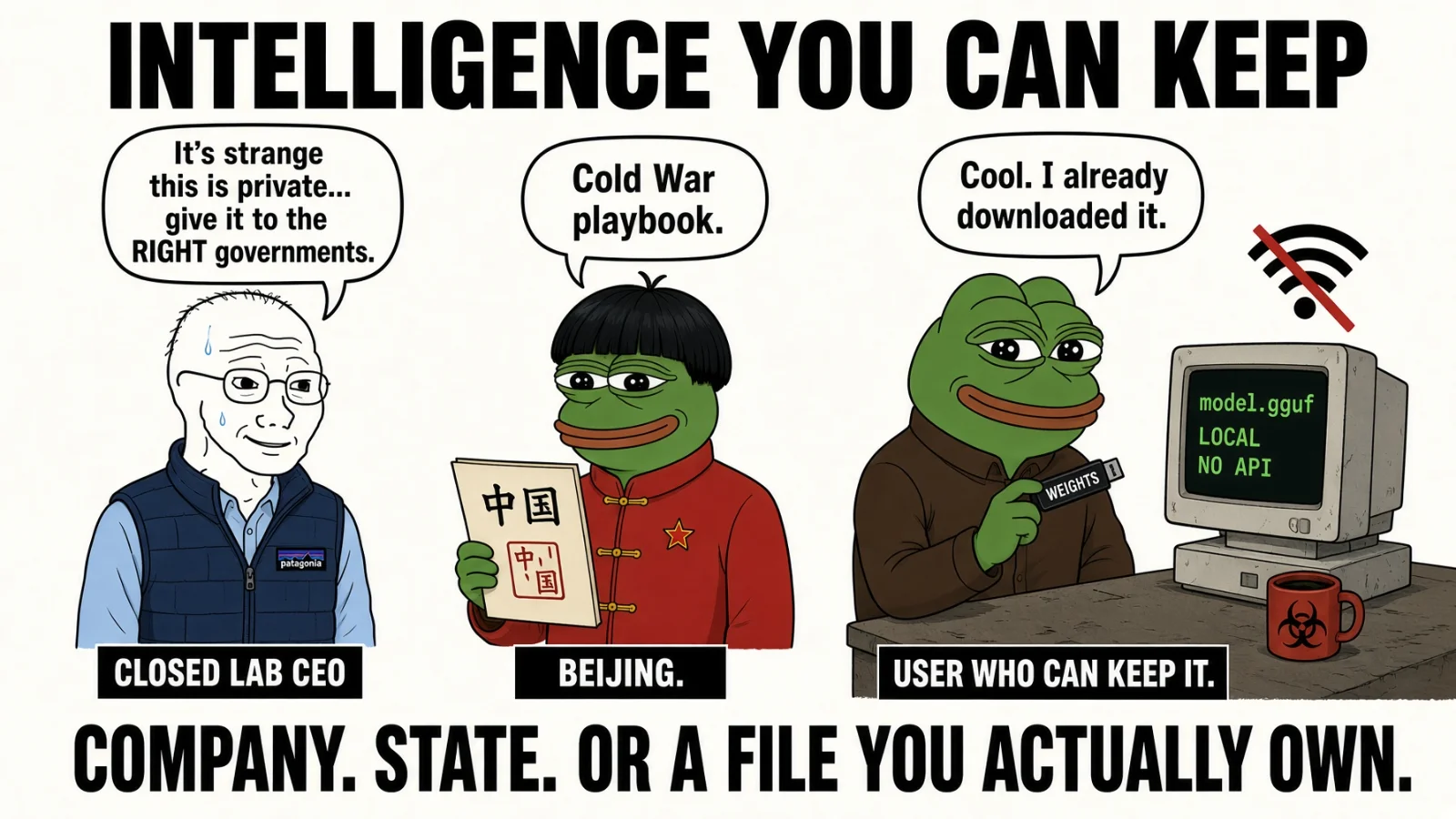
A model you can download and run changes your relationship with its developer. You can keep using it when the company changes its policies, withdraws a product or goes out of business. You can work without sending every question and document to someone else's servers.
I think that's an extraordinary freedom, and one worth protecting alongside the freedom to write, publish and run our own software.
Most discussion about AI still assumes that a few companies will operate the most capable systems and everyone else will buy access. The argument is then about who should supervise those companies. I want the option of using the technology without depending on them at all.
The government alternative
On CBS, Amodei floated joint governance by democratic governments while qualifying the idea of handing over the technology. CBS transcript
His qualifications don't resolve my objection. Replacing exclusive corporate control with a government-backed arrangement doesn't give an ordinary user more independence. It changes who supervises the supplier.
A journalist handling confidential documents needs an alternative to uploading them to a provider. A researcher needs to be able to modify a model without the developer's approval. Neither should have to wait for a company and a government to agree on what access to offer.
There are more possibilities than leaving AI with a handful of private labs or putting those labs under collective state supervision. Widely available models let ownership and experimentation spread well beyond either group, and that's the possibility worth defending.
Beijing has its own interests
Amodei's pacing essay also advocates restrictions on China's access to advanced chips and measures against unauthorised distillation. Amodei's proposal
The response was predictable. China's state-backed Global Times described the approach as a "Cold War playbook." The Foreign Ministry also criticised the confrontational framing and called for cooperation. Reuters, Associated Press
Beijing's objection doesn't make it a defender of my freedom to run a model. A government seeking better terms for its own technology industry is pursuing a different objective.
The exchange shows how quickly a proposal for international supervision becomes a dispute over national advantage. Each government has reasons to resist an arrangement that gives another power control over access to important technology.
I have the same objection at an individual level. I don't want access to my tools settled by negotiations over which countries deserve them, and giving more governments a seat at the table doesn't answer that concern.
A diplomatic agreement might resolve a dispute between states while leaving ordinary users dependent on approved suppliers.
What keeping a model actually buys you
Printing made it easier to circulate arguments. Personal computers put more computing power in individual hands. The internet widened access to publishing. None of that eliminated concentrated power, but each one gave people practical ways to do things that used to require an institution's resources or permission.
Open models can extend that same freedom to work involving language, code and analysis. The useful distinction is whether you can retain and operate the system yourself, rather than merely request results from it.
A hosted service can change its price, retire a version or refuse a task. That may be an acceptable trade for convenience. It becomes a much worse bargain once viable alternatives are restricted.
With a local model, your working setup doesn't have to change just because the developer adopted a new business plan. Depending on the licence and your resources, you can modify it or use someone else's adaptation, and you can investigate its behaviour without losing access midway through the work.
This doesn't require everyone to operate a large model at home. Some systems need expensive hardware, and many people will sensibly choose hosting anyway. The freedom to run models independently also lets other providers compete for those same customers.
What matters is that using a hosted service remains a choice.
Control over the assistant
A widely used AI service can influence what people encounter when they ask for explanations, research help or advice. Its operator chooses how the model is trained and what additional restrictions the service applies.
There's no politically neutral operator who can settle every disputed subject to everyone's satisfaction. Moving those decisions into government doesn't make the disagreement disappear. It gives a different institution the power to decide.
Local models aren't automatically impartial either. They carry the effects of their training, and changing them can require considerable skill and expense. Having the weights isn't the same as understanding everything inside them.
But it gives others something to work with. Researchers can compare versions, investigate refusals and publish modifications, so a developer's decision doesn't have to be the final one for every user.
These tools increasingly participate in writing, learning and private inquiry, which is why I treat this as a matter of intellectual freedom: people should be able to use alternatives that the dominant supplier would never choose to provide.
The risk does not disappear
The strongest objection to releasing weights is that access cannot be limited to people with good intentions. A malicious user may modify a model or remove restrictions, and widely distributed copies are difficult to withdraw.
That risk deserves a serious answer. The printing comparison concerns the freedom to possess a tool; it doesn't establish that AI presents the same dangers. The case against releasing a particular model needs evidence of what it would enable someone to do.
Centralised systems need the same scrutiny. An operator can alter a service used by millions of people, collect sensitive information or restrict access across an entire user base. Government participation doesn't remove those powers or guarantee they'll be used well.
Responsibility should attach to harmful conduct. I oppose requiring official approval to possess a general-purpose tool. Concentrating control also creates risks, including making everyone dependent on decisions they have no practical way to challenge.
Release matters, but so does the licence
Once weights have been widely copied, the original developer has much less practical control over every working copy. A service can be switched off centrally; independent copies can't be withdrawn the same way.
That doesn't make access invulnerable. Distribution channels can disappear, hardware can become harder to obtain, and restrictions can make use costly or unlawful. Keeping a file isn't enough if nobody can get the equipment or permission needed to run it.
Nor does every downloadable model offer the same freedom. A restrictive licence may prevent the use you intended. Missing code or documentation may make modification difficult. A release advertised as open may still leave users dependent on its developer for important parts of the system.
The rights attached to the model matter more than the branding. I want to be able to keep it, run it, inspect it and, where technically possible, change it. I also want other people to be able to publish their improvements. That's the practice worth protecting, whoever produced the original model.
I'll use paid AI services when they're useful. I also want a working copy of a capable model that stays available when a supplier changes its mind or a government objects to what I'm doing. A company can decide what it will host. It shouldn't get to decide what everyone else may possess.
Subscribe to The Ray Report
Get new posts delivered to your inbox.
Optional: get one notification when this blog publishes a new post. You can turn it off in your browser settings.
Related posts

Who Benefits From an AI Safety Pause?
I don't buy the safety explanation coming from the biggest AI labs. Telling the public that your…
The Medium Sucks: What a Crude 2013 Onion Joke Got Right About AI
In 2013, The Onion released a fake product announcement titled New Wearable Computer Also Sucks…

The Convenient Whistleblower
Why a four month Anthropic researcher became the face of AI doom — and who benefits This week a…